
UBD Sustainability
RAKSA Campaign: Recycle All Kinds, Sustain All
At Universiti Brunei Darussalam (UBD), environmental sustainability is not just a goal—it is a shared commitment and a way of life. Leading this effort is RAKSA (Recycle All Kinds, Sustain All)—UBD’s green mascot and the driving force behind its Recycling and Composting Awareness Campaign. More than a symbol, RAKSA is a movement—UBD’s call to action for a cleaner, greener future.
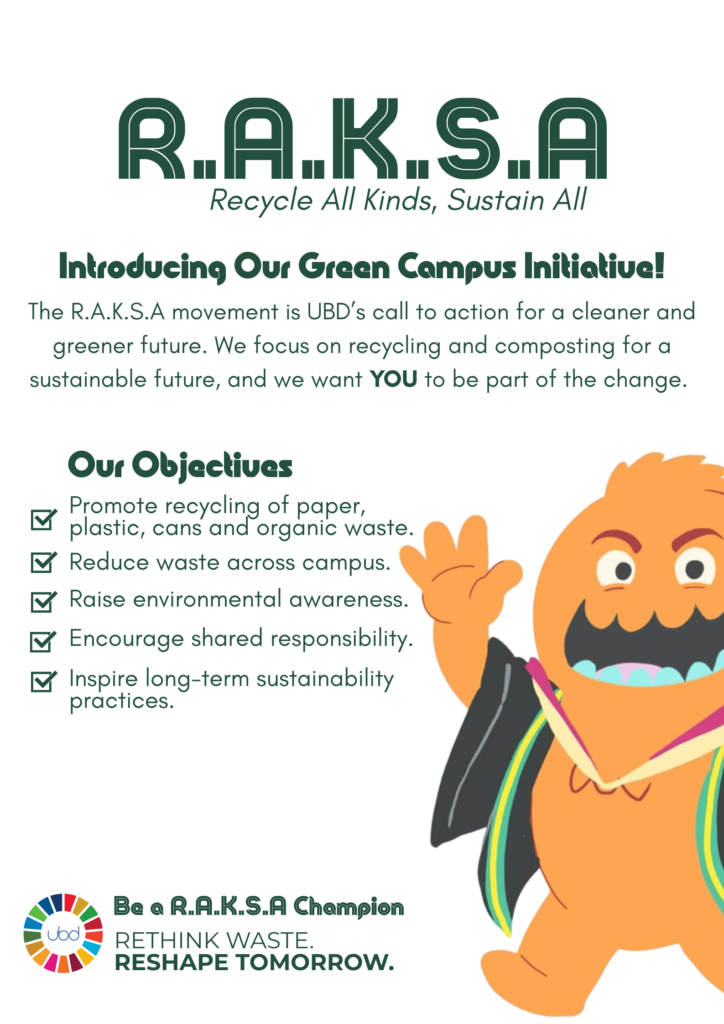
At the heart of the RAKSA campaign is a strong focus on waste segregation at source. The initiative encourages the campus community to sort waste correctly into general waste, recyclable materials (such as paper, plastics and cans) and organic waste for composting. Supporting this, recycling bins are strategically placed across campus, enabling students and staff to conveniently sort waste at source. Through engaging outreach, practical tips and consistent reminders, RAKSA empowers individuals to adopt responsible disposal habits, making segregation simple, visible and actionable.
Complementing these efforts is the Paper Recycling Project, launched in July 2022, which promotes paper reduction, reuse, and responsible disposal practices across the university. To date, the project has successfully collected over 11 tons of printed waste for recycling across two cycles, with plans to continue expanding this initiative as part of our broader environmental sustainability goals.
Together, these initiatives go beyond infrastructure—they shape behaviour, build awareness and cultivate a campus culture where sustainability becomes second nature. More importantly, they contribute directly to UBD’s 2030 target of diverting 50% of total waste away from landfill, advancing the university’s journey towards a circular, low-waste campus.
UBD Waste Management Workflow
So, what actually happens after you throw something away at UBD? Behind the scenes, a well-coordinated system ensures that every piece of waste is managed responsibly—from disposal to final treatment, as illustrated in the workflow diagram
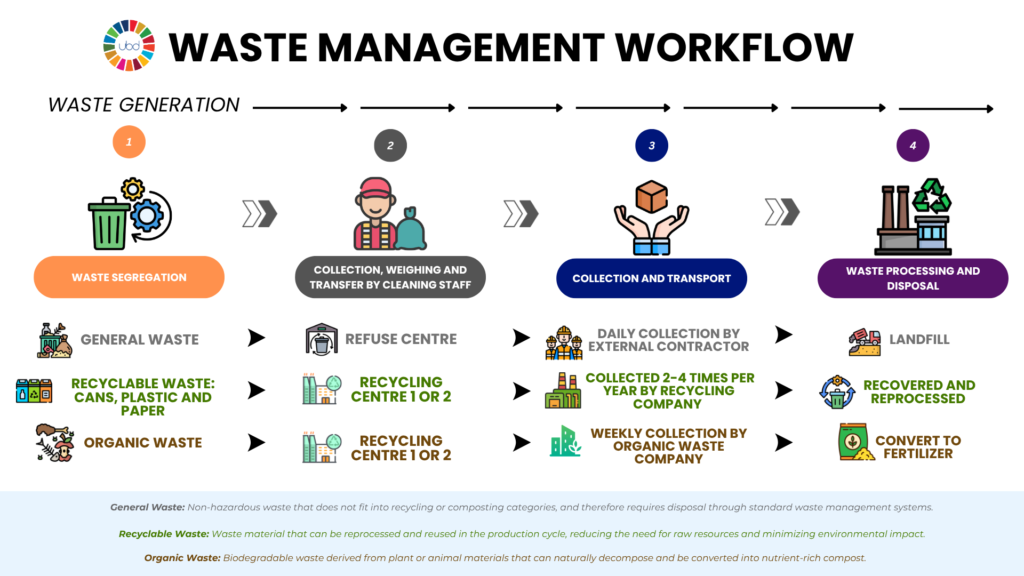
1. Sort at Source
It all starts with you. Waste is separated into:
- General waste (non-recyclable)
- Recyclable waste (paper, plastics, cans, glass)
- Organic waste (food and biodegradable materials)
Clear labelling across campus makes it easy to make the right choice.
2. Collect and Track
Once disposed, cleaning staff take over:
- Waste is collected, weighed, and recorded
- Data is tracked to monitor trends
3. Transport to the Right Channels
Each type of waste is then directed to its proper pathway:
- General waste → Refuse Centre (daily collection by external contractor)
- Recyclables → Recycling Centres (1 or 2), collected by Daikyo Environmental Recycling Sdn Bhd and Kehasan Sdn Bhd.
- Organic waste → Recycling Centre, collected weekly by Biofield Solutions
4. Process and Recover
Here’s where waste gets a second life:
- General waste → safely disposed at landfill
- Recyclables → recovered and reprocessed into new materials
- Organic waste → transformed into nutrient-rich fertiliser (compost), which is returned to the campus to support landscaping and planting initiatives.
Towards a Circular Campus
From the moment waste is generated to how it is recovered, every step at UBD is designed with purpose. Combined with the energy of RAKSA, this system is not just about managing waste—it is about changing mindsets.
Every item recycled, every meal composted and every conscious choice brings us closer to our goal.
Together, we are building a campus where sustainability is not just practiced—but lived.
